AmiGo technology, Project
Intelligent, sustainable and safe? Answers to your questions about AmiGo
Autonomous driving sparks curiosity, but also raises questions: how safe are the vehicles? What happens in the event of a technical problem? And how does artificial intelligence work on board? We answer five frequently asked questions.
Rich Content Section
- Will the vehicles operate on the roads without monitoring after the initial test phase?
- Can AmiGo cope in rain, snow or darkness?
- Does AmiGo use artificial intelligence?
- What happens if AmiGo is unable to continue a journey due to a technical problem?
- Is AmiGo really a sustainable supplement to public transport? Far fewer people can be transported at the same time.
Will the vehicles operate on the roads without monitoring after the initial test phase?
No. Even though the vehicles will be operated without safety drivers in the future, the fleet will be monitored on a permanent basis from the depot in Altstätten. If necessary, a remote operator, the Remote Assistance Officer, can step in and stop the vehicle. The vehicles also have safety functions that bring them to a halt independently and in a controlled manner.
Can AmiGo cope in rain, snow or darkness?
The AmiGo vehicles are equipped with various sensor systems that continually record their surroundings. As well as cameras, these features include radar and LiDAR sensors. Each of these systems has different strengths: cameras provide important image information, for example, while radar sensors remain reliable even in rain or snow. LiDAR technology uses laser pulses to map its surroundings and create an accurate 3D representation of the environment.
The interplay between these systems is crucial. The information from the different types of sensors is combined to ensure that the vehicle can reliably detect other road users, obstacles and the course of the road, even in changing weather and light conditions. AmiGo drives autonomously only if the specified conditions for safe operation are met.
Does AmiGo use artificial intelligence?
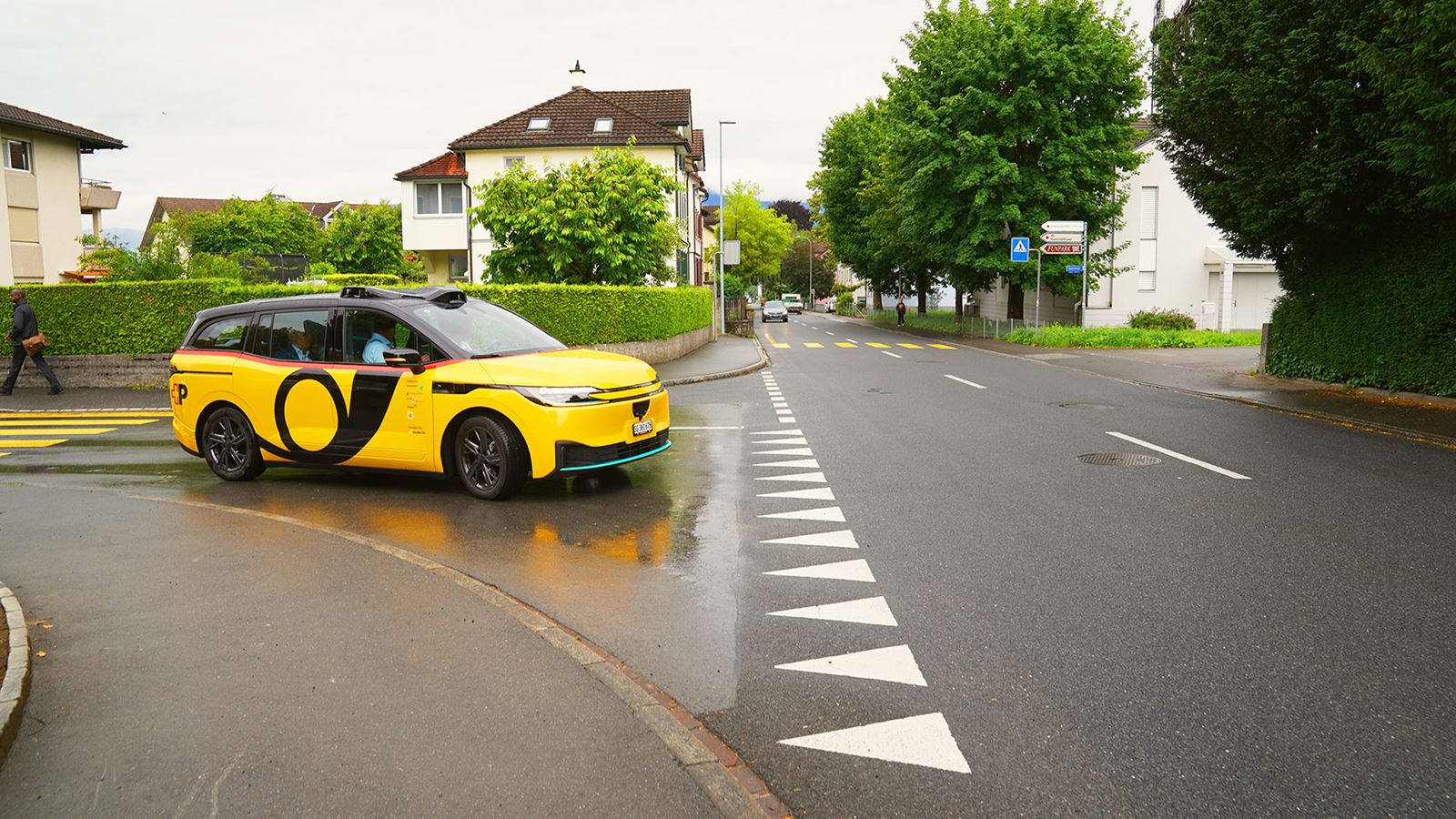
Artificial intelligence plays an important role in autonomous driving. It helps the vehicle to continually record its surroundings and evaluate them within milliseconds. This allows AmiGo to identify pedestrians, bicycles, other vehicles and traffic lights. The system can also reliably estimate how other road users might behave in the next few seconds, for instance if a pedestrian is waiting to cross the road or a car is about to change lanes. The vehicle calculates a safe driving strategy on the basis of this overview and acts accordingly by steering, braking or accelerating.
This is not “general” artificial intelligence, which develops its own consciousness and can even take control. Unlike generative AI (GenAI), which can generate content such as text or images, AI in autonomous vehicles is “specialized AI”. This type of AI is trained to perform clearly defined tasks such as object recognition and driving strategy planning and works within precise framework conditions.
To ensure that the technology functions reliably even under local conditions, the vehicles are trained specifically on Swiss roads and exposed to the local driving culture. Before regular operations begin, vehicle behaviour in the area of deployment is comprehensively tested and gradually optimized.
What happens if AmiGo is unable to continue a journey due to a technical problem?
If the vehicle is unable to continue its journey due to a technical problem, it automatically initiates a predefined safety manoeuvre. This is known as the “minimal risk manoeuvre”, or MRM for short. The vehicle is put in the safest possible condition in a controlled manner and brought to a stop.
The passengers are informed of the situation via loudspeakers inside the vehicle. They can also contact employees directly at any time using the on-board emergency button. The employees are notified immediately and organize the necessary assistance. Depending on the situation, they may come to the vehicle location, or a replacement vehicle may be sent to enable the passengers to continue their journey.
Is AmiGo really a sustainable supplement to public transport? Far fewer people can be transported at the same time.
For on-demand services, empty journeys can be significantly reduced. The vehicles only operate if ordered by the customer.
If several people want to travel in the same direction at a similar time, their journeys can be combined. Other passengers can then board or alight en route. Ride pooling enables several people to share a vehicle and ensures that the available places are used as efficiently as possible.
In addition, PostBus’s future on-demand and autonomous services will be implemented with electrically powered vehicles. AmiGo can make a major contribution to sustainability if it offers people an attractive alternative to owning their own car. If passengers share journeys more frequently or don’t need their own car at all thanks to AmiGo, this will reduce individual car traffic and associated resource consumption.